Micro- and Meso-Analysis
Micro- and Meso-Analysis
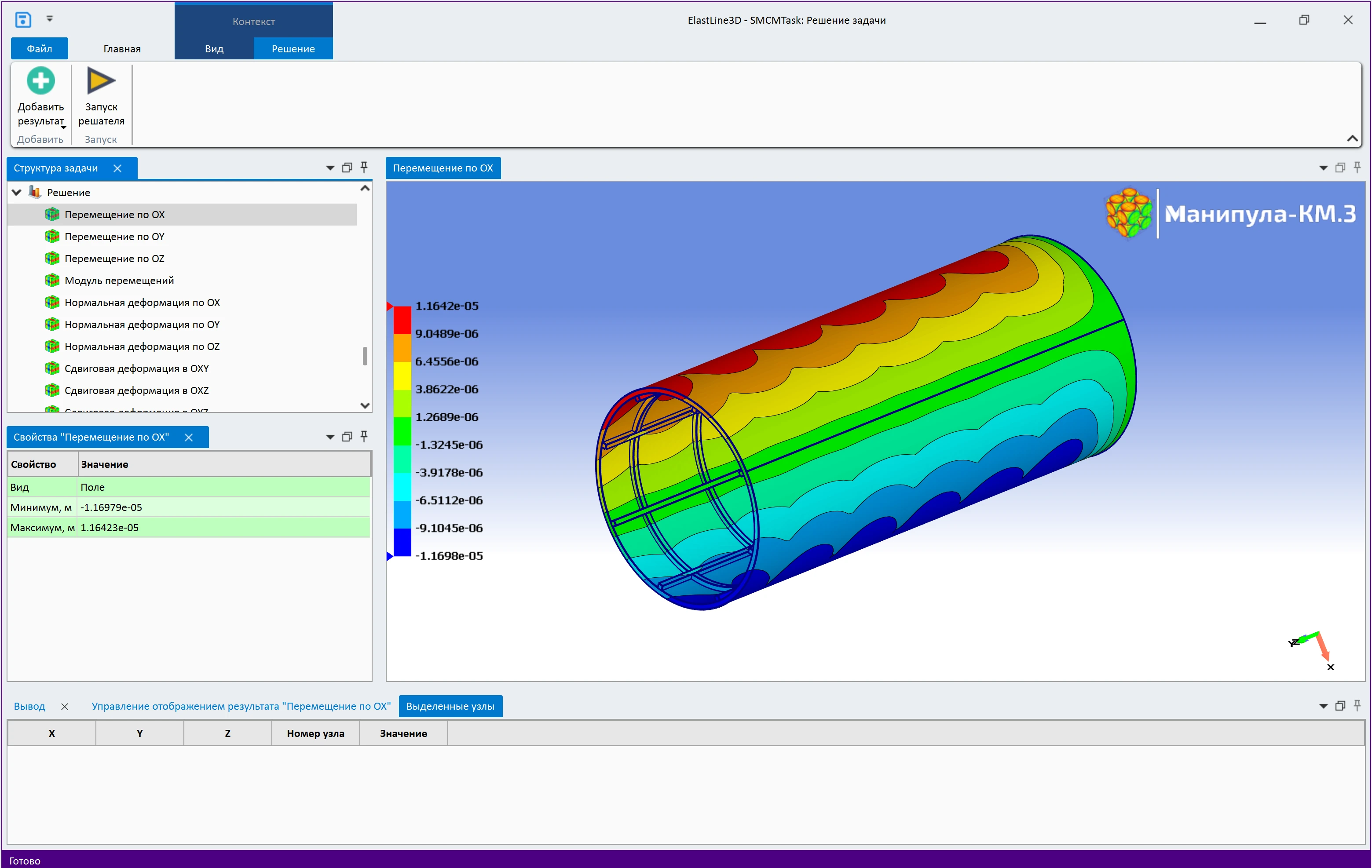
Description
In Manipula/SMCM 4.0, modeling of effective properties of composite materials is implemented using the asymptotic homogenization method (homogenization method). Among Russian and international CAE-class software packages, this solution stands out for its comprehensive list of calculated effective composite properties, including:
- linearly and nonlinearly elastic;
- hyperelastic;
- plastic;
- viscoelastic;
- other properties.
All composite material models in Manipula/SMCM 4.0 comply with the Russian national standard GOST R 57700.42‑2023 «Numerical Simulation of Polymer Composite Materials. General Provisions».
Capabilities
- Thermophysical properties of composite materials (CM):
- thermal conductivity tensor;
- density and specific heat capacity.
- Elastic properties of CM:
- elasticity modulus tensor;
- finite strains;
- thermal expansion tensor;
- nonlinear elasticity (stress‑strain curves);
- anisotropic nonlinear elasticity.
- Elastic‑plastic properties of CM:
- deformation theory of plasticity (stress‑strain curves);
- deformation theory of anisotropic plasticity.
- Strength properties of CM:
- stress‑strain curves up to failure;
- ultimate strength limits.
- Viscoelastic properties of CM:
- complex elasticity modulus tensor;
- creep and relaxation kernel tensors.